
Across the United States, a quiet crisis is unfolding in classrooms, playgrounds, and homes. Boys are falling behind their female peers in reading and writing, earning lower grades, and graduating high school at lower rates. They also report lower motivation, weaker emotional regulation, and higher rates of behavioral or developmental concerns.
This growing gender gap—often called “the boy crisis”—isn’t about boys versus girls, but about how our education and support systems can better serve both. As educators, therapists, and parents strive to meet every child’s needs, data shows that boys are struggling in key areas that affect their future success and mental health. Soliant’s Boy Crisis Index set out to measure just how deep this disparity runs and where the solutions are already taking shape.
About the Research: Measuring the Gender Gap
The Boy Crisis Index evaluates where boys across the country are falling behind—or thriving—compared to girls. Using ten equally weighted indicators, the Index analyzes gender differences in:
- Academic performance (reading, math, grades, graduation rates)
- Emotional and behavioral regulation (resilience, bullying, motivation)
- Social development (friendship and extracurricular involvement)
- Mental and developmental health
Each indicator was standardized into a composite score, allowing states to be ranked from those showing the greatest gender gaps to those achieving the strongest parity. Data was pulled from trusted national sources such as the U.S. Department of Education and the Health Resources and Services Administration, reflecting the most recent findings.
The goal of the Boy Crisis Index is to highlight where boys need more targeted support—and where schools and communities are successfully closing the gap.
Key Findings: Where Boys Are Struggling Most
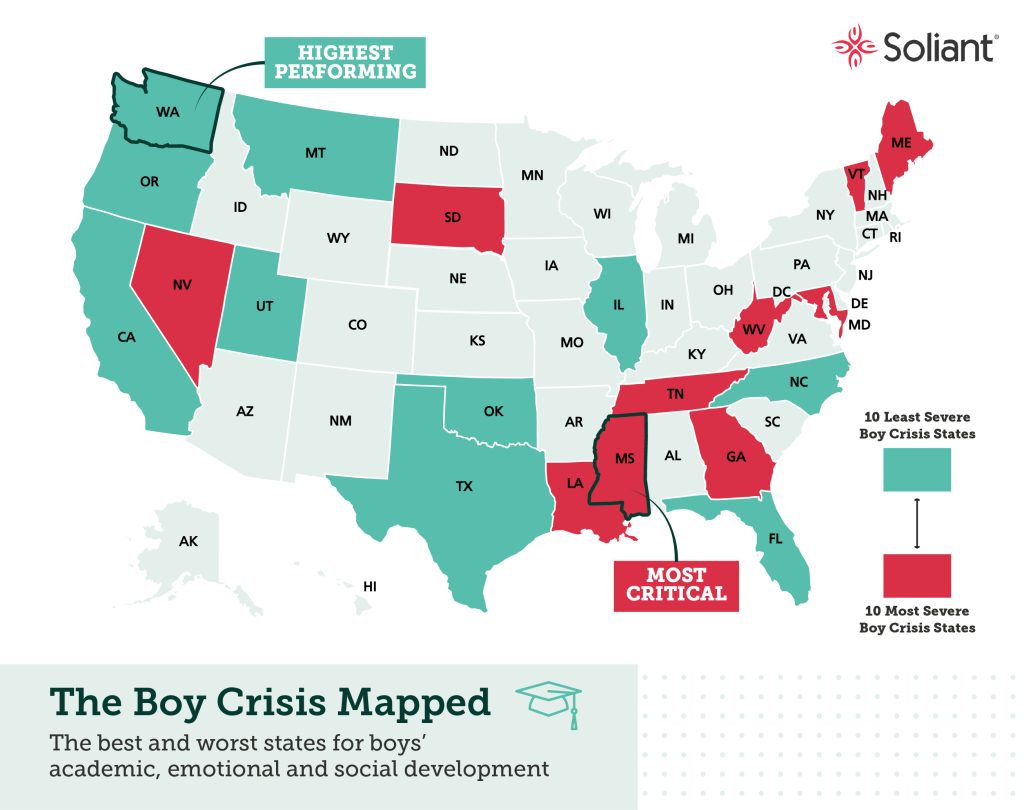
At the top of the list, Mississippi, Maryland, and Vermont rank as the three states where boys face the steepest challenges.
Mississippi shows some of the widest disparities nationwide: boys graduate at rates 8 points lower than girls, show 20-point gaps in motivation, and are far less likely to participate in extracurricular activities. Limited access to enrichment and emotional-learning resources may be compounding these issues.
In Maryland, the gender divide is particularly emotional. Boys report dramatically lower levels of self-control under stress (a 14-point gap) and face one of the nation’s largest reading gaps—11 points lower than girls on standardized tests.
Vermont reveals the starkest motivational divide in the country: only 30% of boys report caring about doing well in school, compared to 64% of girls. That disengagement is mirrored in grades, friendships, and behavior, suggesting a systemic lack of engagement and belonging for boys.
Together, these states paint a troubling picture of boys who are academically unmotivated, socially isolated, and emotionally under-supported.
Breakdown: Top 3 Most Severe Boy Crisis States
- Mississippi
- Graduation Rates – Mississippi ranks 4th worst for graduation disparity, with 78% of boys graduating compared to 86% of girls—an 8-point gap. This suggests systemic barriers or engagement issues preventing boys from completing school at equal rates.
- Math Scores (NAEP) – Boys in Mississippi trail girls in Grade 8 math performance, tying for the nation’s worst gender gap (alongside Georgia). Average scores of 268 for boys and 270 for girls highlight early academic inequalities that can persist into high school.
- Cares About School Performance – With a 20.6-point gap (46.7% of boys vs. 67.3% of girls), boys in Mississippi show significantly lower academic motivation, indicating disengagement that may compound other educational challenges.
- Managing Challenges – Boys are also less emotionally resilient, with 21% of boys versus 32% of girls staying calm under pressure—an 11-point gap. This may reflect limited access to emotional support or SEL programming.
- Mostly A Grades – Mississippi ranks 2nd worst for academic achievement disparity, with only 16.7% of boys versus 40.3% of girls reporting “mostly A’s.” Boys appear less likely to reach top academic performance benchmarks.
- Extracurricular Activities – Boys also participate less in organized activities (62.6% vs. 75.7% for girls, a 13.1-point gap), suggesting fewer opportunities for enrichment, mentorship, and peer engagement outside the classroom.
- Maryland
- Graduation Rates – Maryland ranks 11th worst for graduation parity, with 82.6% of boys graduating compared to 88.8% of girls—a 6.2-point gap. This shows a measurable difference in educational attainment.
- Reading Scores (NAEP) – Boys score 11 points lower on Grade 8 reading (253 vs. 264), one of the largest national gaps, reflecting persistent literacy challenges among male students.
- Managing Challenges – Maryland has the widest gap in emotional regulation nationwide, with only 15.4% of boys versus 29.5% of girls staying calm when faced with challenges—a 14.1-point gap. This suggests significant emotional stress or lack of coping resources among boys.
- Making and Keeping Friends – Boys also struggle socially, with a 7.7-point gap (67.9% of boys vs. 75.6% of girls reporting no friendship difficulty). These gaps may indicate challenges in social connection and emotional expression.
- Bullied Others – The state also ranks among the worst for bullying disparity, with 84.2% of boys and 91.9% of girls reporting non-bullying behavior—a 7.7-point difference. This suggests boys may be more likely to engage in or experience social conflict.
- Vermont
- Cares About School Performance – Vermont shows the largest motivation gap in the country, with only 30.2% of boys versus 64.2% of girls caring about doing well in school—a staggering 34-point gap. This indicates serious disengagement among boys toward academics.
- Making and Keeping Friends – Boys report more social difficulty, with 72.9% saying they have no trouble keeping friends compared to 78.5% of girls—a 5.6-point gap. This may reflect higher social isolation among boys.
- Mostly A Grades – Vermont ranks 3rd worst for academic achievement disparity, with just 21.2% of boys versus 44.2% of girls earning mostly A’s—a 23-point gap, showing a pronounced academic performance divide.
- Bullied Others – Vermont also ranks 1st for the largest bullying behavior gap, with only 72.2% of boys and 82% of girls reporting they never bully others—a 9.8-point difference, suggesting greater behavioral or social difficulties among boys.
Key Findings: Where the Boy Crisis is Minimal
The Index also reveals encouraging examples from states narrowing the gap. Washington, Oregon, and Illinois lead the nation in supporting boys’ academic and social development.
In Washington, boys report almost equal motivation levels to girls (a modest 7-point gap) and even higher resilience when faced with challenges. Washington also ranks #1 for boys’ social connectedness—74% say they have no trouble making or keeping friends. These results suggest a school culture that values emotional intelligence and inclusion as much as grades.
Oregon excels in graduation parity and emotional regulation, while also showing smaller gaps in bullying behavior. Access to mental-health initiatives and structured after-school activities appear to be key contributors.
Illinois demonstrates balance across both academic and behavioral domains, with boys showing nearly equal graduation rates and strong empathy indicators—a promising sign that social-emotional programs can make measurable differences.
Breakdown: Top 3 States Where Boys Are Thriving
- Washington
- Cares About School Performance – Boys in Washington show one of the smallest gender gaps in caring about academic success, ranking 2nd nationally. Nearly half (48%) of boys report caring about doing well in school compared to 55.4% of girls—a modest 7.4-point gap. This balance suggests Washington schools may be fostering motivation and engagement across genders.
- Managing Challenges – Washington ranks 2nd for the smallest gap in emotional self-regulation, with 22.6% of boys and 15.2% of girls saying they stay calm when faced with challenges. The slightly higher percentage among boys indicates they may be developing resilience and coping skills at similar or even higher levels than their female peers.
- Making and Keeping Friends – Washington ranks 1st nationwide for boys’ social inclusion, with 74.3% of boys and 64.4% of girls reporting no difficulty making or keeping friends—a 9.9-point advantage for boys. This highlights a strong culture of social connectedness and peer belonging among boys in the state.
- Oregon
- Graduation Rates – Oregon ranks 4th nationally for gender parity in high school graduation rates. With 85.2% of boys and 88% of girls graduating—a small 2.8-point gap—Oregon demonstrates strong academic support systems that help both genders reach the finish line.
- Managing Challenges – The state ranks 8th for balance in emotional regulation, with 22.2% of boys and 19.8% of girls staying calm when facing challenges—a minimal 2.4-point difference. This reflects consistent emotional development and coping skills among Oregon’s students.
- Bullied Others – Oregon ranks 3rd for the smallest gap in bullying behavior, with 81.3% of boys and 77.6% of girls reporting they never bully or exclude others—a 3.7-point difference favoring boys. This suggests boys in Oregon are equally or even less likely to engage in bullying compared to girls.
- Illinois
- Graduation Rates – Illinois ranks 6th for graduation rate parity, with 86.2% of boys and 89.3% of girls graduating high school—a 3.1-point difference. This narrow gap shows that boys and girls in Illinois are completing school at nearly equal rates.
- Making and Keeping Friends – Illinois ranks 10th for the smallest friendship gap, with 78.1% of boys and 74.7% of girls reporting no difficulty maintaining friendships—a 3.4-point difference. This indicates strong peer relationships among boys, a key factor in emotional well-being.
- Bullied Others – The state ranks 4th for gender balance in non-bullying behavior, with 87.4% of boys and 83.8% of girls saying they never bully or exclude others. This suggests boys in Illinois exhibit strong empathy and positive social behavior compared to national trends.
The Boy Crisis: How States Compare
| Boy Crisis Severity Rank | State | Total Score |
|---|---|---|
| 1 | Mississippi | 72.42 |
| 2 | Maryland | 63.61 |
| 3 | Vermont | 61.05 |
| 4 | Nevada | 60.77 |
| 5 | Louisiana | 60.08 |
| 6 | Georgia | 59.94 |
| 7 | Tennessee | 57.73 |
| 8 | Maine | 57.24 |
| 9 | West Virginia | 57.16 |
| 10 | South Dakota | 56.89 |
| 11 | Arkansas | 55.78 |
| 12 | Connecticut | 54.19 |
| 13 | Kansas | 54.05 |
| 14 | Nebraska | 53.02 |
| 15 | Kentucky | 50.34 |
| 16 | Rhode Island | 49.96 |
| 17 | Colorado | 49.61 |
| 18 | Wisconsin | 49.44 |
| 19 | New York | 49.21 |
| 20 | Alaska | 49.20 |
| 21 | Virginia | 48.36 |
| 22 | Idaho | 47.23 |
| 23 | Hawaii | 47.03 |
| 24 | New Hampshire | 46.97 |
| 25 | Alabama | 46.92 |
| 26 | Missouri | 46.49 |
| 27 | Delaware | 46.34 |
| 28 | Pennsylvania | 46.07 |
| 29 | Wyoming | 45.92 |
| 30 | Minnesota | 44.79 |
| 31 | Arizona | 44.66 |
| 32 | Massachusetts | 44.43 |
| 33 | New Mexico | 44.26 |
| 34 | South Carolina | 43.43 |
| 35 | Iowa | 43.32 |
| 36 | Indiana | 43.16 |
| 37 | North Dakota | 42.79 |
| 38 | Ohio | 42.45 |
| 39 | New Jersey | 41.75 |
| 40 | Michigan | 41.20 |
| 41 | North Carolina | 40.49 |
| 42 | Florida | 39.84 |
| 43 | Montana | 39.48 |
| 44 | California | 36.33 |
| 45 | Oklahoma | 35.75 |
| 46 | Utah | 34.43 |
| 47 | Texas | 32.72 |
| 48 | Illinois | 32.00 |
| 49 | Oregon | 29.20 |
| 50 | Washington | 26.04 |
Why It Matters: The Ripple Effect of Disengaged Boys
The “boy crisis” doesn’t end in the classroom. When boys disengage early—academically, socially, or emotionally—the effects ripple into adulthood: higher dropout rates, lower college attendance, increased loneliness, and greater vulnerability to mental health struggles.
This crisis also affects the classroom ecosystem. School professionals report more behavioral disruptions, reduced peer empathy, and uneven participation. For girls, that imbalance can lead to overperformance pressure; for boys, it can lead to withdrawal or acting out. Recognizing these patterns is the first step toward restoring balance for everyone.
Strategies and Solutions for Schools
Soliant experts recommend the following approaches for districts and educators working to close the gender gap:
- Invest in early intervention: Provide counseling and emotional-regulation programs in elementary school, before academic disengagement begins.
- Prioritize mentorship and role models: Connect boys with positive male and female mentors who reinforce empathy, perseverance, and curiosity.
- Expand extracurricular access: Sports, robotics clubs, and music lessons build social belonging and confidence, particularly for boys at risk of isolation.
- Integrate social-emotional learning (SEL): Teach emotional vocabulary, stress management, and conflict resolution to help boys express feelings constructively.
- Collaborate with school-based therapists: Mental and behavioral health specialists can help identify unseen struggles and tailor individualized support plans.
When educators, families, and therapy providers collaborate, boys are more likely to stay motivated, regulated, and engaged—all benefits that extend to their peers and communities as well.
At Soliant Health, we believe every child deserves equal opportunity to learn, grow, and thrive—regardless of gender. Our nationwide network of school psychologists, speech-language pathologists, behavioral therapists, and special education professionals plays a crucial role in identifying and addressing the root causes of the boy crisis. Learn more about how we equip schools with the experts and resources needed to help every student succeed here.
Methodology
The Boy Crisis Index evaluates where boys across the United States are falling behind—or thriving—relative to their female peers. The Index analyzes ten equally weighted indicators (10% each) spanning academic achievement, emotional well-being, behavior, and social development. For each indicator, the relative gender disparity was calculated by determining the percentage-point or score-point difference between male and female outcomes, with positive values indicating areas where girls outperform boys. These standardized differences were then combined to generate a composite score ranking each state by the severity of its gender gap. All data reflect the most recent available state-level statistics from reputable national sources, including the U.S. Department of Education and the National Survey of Children’s Health.
Sources & Data Points
High School Graduation Rates
Relative difference (percentage points) between male and female public high school Averaged Freshman Graduation Rates (AFGR) for the 2022–23 school year. Arizona reflects 2012–13 data, the most recent available.
Source: U.S. Department of Education, National Center for Education Statistics, Common Core of Data (CCD).
NAEP Mathematics Scores (2024)
Relative difference (score points) between average Grade 8 mathematics scale scores for males and females.
Source: U.S. Department of Education, Institute of Education Sciences, National Center for Education Statistics, National Assessment of Educational Progress (NAEP).
NAEP Reading Scores (2024)
Relative difference (score points) between average Grade 8 reading scale scores for males and females.
Source: U.S. Department of Education, Institute of Education Sciences, National Center for Education Statistics, National Assessment of Educational Progress (NAEP).
Cares About Doing Well in School
Relative difference (percentage points) between boys and girls ages 6–17 who report caring about doing well in school (2023).
Source: National Survey of Children’s Health, Health Resources and Services Administration, Maternal and Child Health Bureau.
Bullied Others
Relative difference (percentage points) between boys and girls ages 6–17 who report never bullying, picking on, or excluding others in the past 12 months (2023).
Source: National Survey of Children’s Health, Health Resources and Services Administration, Maternal and Child Health Bureau.
Managing Challenges
Relative difference (percentage points) between boys and girls ages 6–17 who report staying calm and in control when faced with challenges (2023).
Source: National Survey of Children’s Health, Health Resources and Services Administration, Maternal and Child Health Bureau.
Making and Keeping Friends
Relative difference (percentage points) between boys and girls ages 6–17 who report having no difficulty making or keeping friends compared to peers (2023).
Source: National Survey of Children’s Health, Health Resources and Services Administration, Maternal and Child Health Bureau.
Mostly A Grades
Relative difference (percentage points) between boys and girls ages 12–17 who reported receiving “mostly A’s” across all subjects during the 2022–23 school year.
Source: National Survey of Children’s Health, Health Resources and Services Administration, Maternal and Child Health Bureau.
Extracurricular Activities
Relative difference (percentage points) between boys and girls ages 6–17 who participated in any organized activities or lessons after school or on weekends within the past 12 months (2023).
Source: National Survey of Children’s Health, Health Resources and Services Administration, Maternal and Child Health Bureau.
Mental, Emotional, Developmental, or Behavioral Problems
Relative difference (percentage points) between boys and girls ages 3–17 reported to have a mental, emotional, developmental, or behavioral (MEDB) problem (2023).
Source: National Survey of Children’s Health, Health Resources and Services Administration, Maternal and Child Health Bureau.