From Application to Interview: The Resume Excellence Playbook

Resume Formatting Standards: What Hiring Managers Expect

At Soliant, we advocate for you. Your resume is your professional introduction to hiring managers. Many great candidates miss opportunities because of formatting issues, missing information, or unclear experience. This guide will help ensure your resume clearly and professionally reflects your expertise.

1. Start with a Clean, Professional Format

Hiring managers typically scan resumes quickly. A cluttered format can unintentionally distract from your qualifications.

Best Practices:

  • Use a standard font (Calibri, Arial, Times New Roman)
  • Font size 10–12 pt
  • 0.5–1 inch margins
  • Consistent spacing
  • Black text only
  • Save as a PDF (unless your recruiter requests otherwise)

Avoid:

  • Tables or columns (they often break when submitted)
  • Text boxes
  • Graphics or headshots
  • Logos or decorative elements
  • Colored fonts
  • Multiple font styles

If it looks like a flyer, it’s too busy. If it looks like a clean professional document, you’re on the right track.
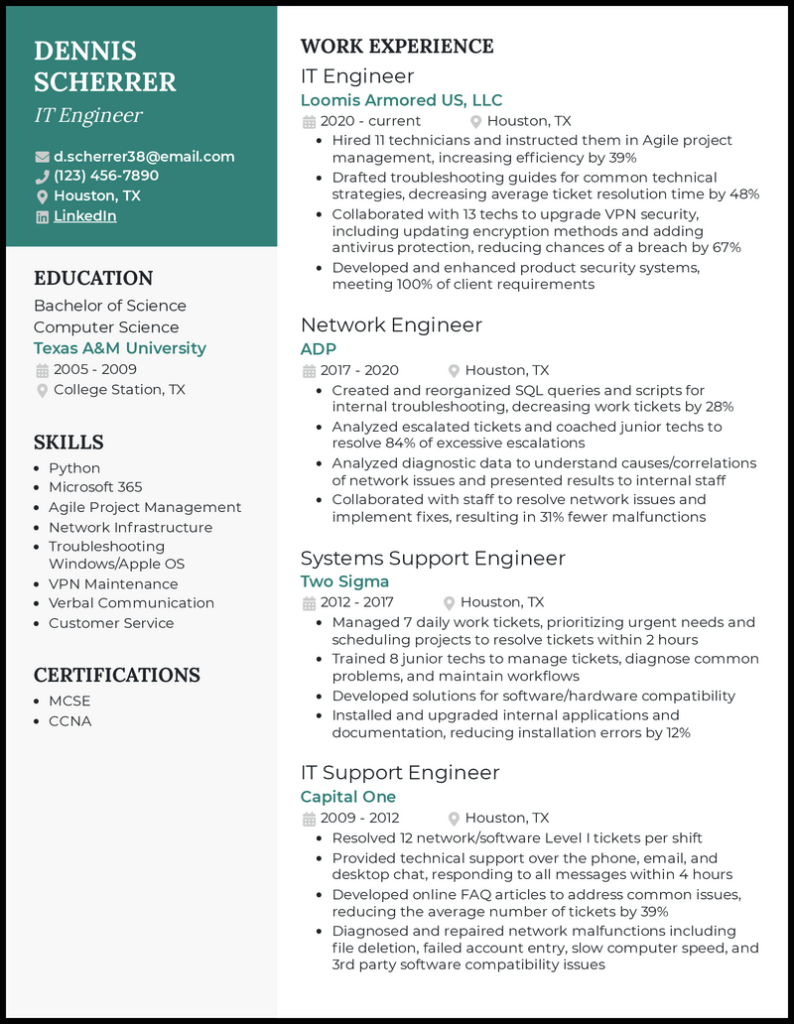
Example of an optimized resume

2. The Essentials

Header

  • Full name
  • Phone number
  • Professional email
  • City & state (no full address needed)
  • License number (if applicable)

Professional Summary (3–4 lines max)

The professional summary is no longer mandatory. It is strategic.

Some recruiters skip it. Some love it. Some only care if it adds clarity. The key question is not “Should I have one?” It is “Does it help?” Let’s break this down:

When a Professional Summary Helps

  • You are changing industries
  • You have contract or short-term roles that need context
  • You have 10+ years of experience and need positioning
  • You want to control your narrative
  • Your title alone does not clearly communicate your value

A strong summary quickly answers:

  • Who are you?
  • What do you specialize in?
  • What level are you?

Modern Example: Operations professional with 8+ years leading cross-functional teams in fast-paced environments. Experienced in process optimization, compliance oversight, and stakeholder communication. Known for improving workflow efficiency while maintaining regulatory standards.

3. Experience Section: Be Specific and Results-Focused

List positions in reverse chronological order. For each role, include:

  • Job Title
  • Organization Name
  • City, State
  • Month/Year – Month/Year
  • 3–6 bullet points

Strong Bullet Point Formula:

Action + Responsibility + Impact

Example:

  • Managed a caseload of 45 clients, ensuring timely documentation and compliance with regulatory standards.
  • Collaborated with cross-functional teams to improve service delivery efficiency.

Avoid:

  • Paragraph blocks
  • Vague statements like “Responsible for duties”
  • Copying the full job description
  • Leaving unexplained employment gaps

Be clear and concise. Your recruiter may help refine the language, but the core information must be accurate and detailed.

4. Licensure, Certifications, & Credentials

  • License type
  • License number
  • State issued
  • Expiration date
  • Certifications
  • Relevant trainings

Hiring managers need to verify eligibility quickly. If this section is unclear or missing, it may delay submission.

5. Education Section

  • Degree
  • Institution
  • Graduation year (or expected graduation date)
  • Relevant honors if applicable

6. Skills Section

List relevant hard skills only:

  • Software proficiency
  • Clinical tools
  • Technical competencies
  • Language fluency

Avoid generic soft skills like:

  • “Hard worker”
  • “Team player”
  • “Motivated”

Your experience section should demonstrate those qualities.

7. Keep It to 1–2 Pages

  • Under 10 years experience: 1 page preferred
  • 10+ years: 2 pages max

Longer resumes are rarely read in full. Prioritize relevance.

8. Common Resume Mistakes That Delay Submission

  • Spelling or grammar errors
  • Inconsistent dates
  • Missing contact information
  • Missing licensure details
  • Unprofessional email address
  • Overly complex formatting
  • Submitting screenshots instead of documents
  • Sending resumes in Google Docs “view only” format
  • Submitting a resume that doesn’t match your LinkedIn profile

Before sending, ask yourself: If I were the hiring manager, could I quickly understand my qualifications?

9. How to Partner Effectively with Your Soliant Recruiter

Your recruiter is your advocate. The stronger your materials, the stronger your submission.

  • Respond promptly to document requests
  • Be transparent about availability
  • Communicate preferences clearly
  • Update your resume with recent assignments
  • Inform us immediately of interviews or offers outside Soliant

A clear resume + clear communication = faster interviews.

10. Final Resume Checklist

Before sending your resume to Soliant, confirm:

☐ Formatting is clean and simple
☐ All dates are consistent and accurate
☐ Licenses and certifications are clearly listed
☐ No spelling or grammar errors
☐ Contact information is current
☐ Saved as a PDF/Word Doc
☐ File name is professional (FirstName_LastName_Resume.pdf)

Resume Best Practices in the Age of AI

Write for humans first.
Old advice said: “Stuff it with keywords.”

But the new reality is that most ATS systems now parse context. Over-stuffing keywords makes resumes feel robotic and lowers credibility. Instead, mirror the job description language where appropriate and naturally integrate relevant keywords.

Use AI wisely.
AI tools can help draft your resume, but always personalize the content. Add real examples, numbers, and specific details. Generic, overly polished language is easy to spot.

Metrics matter more than ever.
Whenever possible, include measurable results (team size, caseload, volume, timelines, efficiency improvements). Specificity stands out.

For example, instead of:
“Managed client relationships.”

Use:
“Managed 35+ active client accounts with 98% retention rate.”

Keep formatting ATS-friendly.
Avoid tables, columns, graphics, and decorative templates from Canva. If your resume reads cleanly when pasted into a plain text document, you’re safe.

Align with your LinkedIn profile.
Recruiters frequently cross-check. Your resume and LinkedIn should tell the same story. Not identical. But aligned. Ensure job titles, dates, and responsibilities are consistent across platforms.

Tailoring is no longer optional.
AI tools now score candidates based on alignment with job descriptions.

One generic resume sent to 50 jobs is less effective than:

  • 3 tailored versions for 3 types of roles

Candidates should:

  • Reorder bullet points for relevance
  • Adjust keywords
  • Adjust summary

The Soliant Resume Template

Next Steps

At Soliant, we work with organizations that prioritize professionalism, compliance, and efficiency. A strong resume helps us present you as a confident, qualified candidate who is ready to contribute from day one. We are here to help but your resume is the foundation. If you would like resume feedback before submission, let us know. We’re happy to partner with you.

Travel vs Perm Radiation Therapist Jobs

Traveling or Staff Radiation Therapist: Which Role is Right for You?

Radiation therapists play a crucial role in oncology by using radiation to treat cancer and other diseases. As with many healthcare careers, radiation therapy offers both travel and permanent job opportunities, each with its own set of benefits and challenges.

Understanding the differences between these two career paths can help you make an informed decision about which option aligns best with your career goals, lifestyle, and personal preferences. To help you weigh your options, this Soliant guide breaks down the details of each role, compares the pros and cons, and gives you a glimpse into salary and growth opportunities.

Can a Radiation Therapist Travel?

Yes, radiation therapists can take on a traveling career with travel radiation therapist jobs, which are typically short-term assignments, ranging from a few weeks to several months. Often in locations across the country, these roles offer flexibility and the chance to explore new places while continuing to work in your field.

Travel radiation therapists are employed by staffing agencies, which arrange assignments at hospitals, cancer centers, and treatment facilities in need of temporary staff. Travel therapists can work in various environments, gaining experience in different facilities and treating a diverse range of patients.

What Are Permanent Radiation Therapist Jobs?

Permanent radiation therapist jobs are full-time, long-term positions at a specific hospital or healthcare facility. In these roles, therapists’ work schedules are more predictable, often offering standard hours, benefits, and a consistent team environment. Permanent positions provide job stability, opportunities for career advancement, and the chance to build relationships with patients and colleagues over time. These roles are ideal for professionals who prefer stability and long-term growth within a single location.

Travel vs Permanent Radiation Therapist Jobs: Pros and Cons

To better understand the differences between travel and permanent radiation therapist jobs, let’s compare the key factors that might influence your decision:

FactorTravel Radiation TherapistPermanent Radiation Therapist
Job Duration

Short-term assignments (a few weeks to several months)Full-time, long-term employment
LocationFlexibility to work in various cities or statesFixed location at one healthcare facility
Work ScheduleFlexible, often with varying hours based on assignmentStandard working hours (day shifts, weekends, etc.)
CompensationTypically higher pay rates, plus travel and housing stipendsSteady salary, with benefits (health insurance, retirement plans, etc.)
Job StabilitySomewhat less stable, as assignments end after a contract periodHigh job stability with long-term employment
ExperienceOpportunity to gain diverse experience in different settings with different patient populationsOpportunities for long-term professional development within a specific team
Career AdvancementLimited due to short-term positions, but good for broadening experienceOpportunities for promotions and specialized roles within the organization
BenefitsHealth, housing, and travel stipends are usually providedFull benefits packages are usually provided (healthcare, paid time off, retirement plans, etc.)
Work-Life BalanceFlexibility to explore new places and enjoy unique experiencesPredictable work-life balance with set schedules and time off
Social InteractionBuild a network of personal and professional relationships across the country, connecting with diverse teamsStronger bonds with coworkers and patients over time

Permanent vs Travel Radiation Therapist Salary

Salary is a crucial factor to consider when evaluating career options. Travel radiation therapists typically earn higher pay rates compared to their permanent counterparts due to the temporary nature of the work, the need for flexibility, and the associated travel requirements. In addition, travel radiation therapists often receive stipends for housing, meals, and transportation, which can significantly boost their total compensation.

However, it’s important to note that the salary can range greatly depending on the cost of living in a city, therapist experience, facility type, and the current demand for therapists.

  • Travel Radiation Therapist Salary: Typically around $2,000 per week, with additional stipends for housing and travel expenses.
  • Permanent Radiation Therapist Salary: Generally ranges from $70,000 to $90,000 per year, depending on location, experience, and the healthcare facility.

Job Opportunities as a Travel vs Staff Radiation Therapist

Both travel and permanent radiation therapist positions offer ample job opportunities, though the type of work and the settings available can differ.

  • Travel Radiation Therapist Opportunities: Travel jobs are ideal for those who want to experience new locations and work in a variety of healthcare settings. There is a high demand for travel radiation therapists in underserved areas or regions with high patient volume. Hospitals, cancer centers, and private practices across the U.S. are often seeking temporary staff, making it relatively easy to find assignments in different locations.
  • Permanent Radiation Therapist Opportunities: Permanent roles are typically available in hospitals, cancer centers, and outpatient clinics. These positions offer the chance to work in a stable environment and build long-term relationships with patients and coworkers. While the job opportunities are still strong, they may be more limited in terms of location flexibility compared to travel roles.

Find the Best Radiation Therapist Job for You

Both travel and permanent radiation therapist jobs have their unique benefits, and the best choice ultimately depends on your personal preferences and career goals. Whether you’re looking for the flexibility to explore new places and gain varied experience, or you prefer the stability and growth potential of a permanent position, Soliant Health offers a wide range of opportunities to match your aspirations.

Ready to take the next step in your radiation therapy career? Browse Soliant’s radiation therapist job listings today to find the perfect position that fits your needs—whether it’s a travel or permanent role.

Looking for more information about radiation therapy? Browse Soliant’s additional resources on radiation therapy career guides, including a resume guide and template, here.

Radiation Therapy Career Guide for New Grads

Exploring a Radiation Therapist Career Post-Graduation

Starting your career as a radiation therapist after years of studying and clinical training is an exciting change—you’ve put in the work, completed your program, and now you’re ready to make the jump from student to full-time professional!

Whether you’ve just graduated or are wrapping up your clinicals, this Soliant guide is here to help you take the next step into a career as a radiation therapist.

How to Get Started in Radiation Therapy as a New Grad

You’ve already completed your radiation therapy education—so what’s next? Here are the final steps to launch your career:

1. Complete Your Certification

After completing an accredited radiation therapy program, you’ll need to pass the American Registry of Radiologic Technologists (ARRT) certification exam. The ARRT exam tests you on the knowledge and skills you’ve learned during your program and are required to perform radiation therapy, including understanding anatomy, radiation safety, and medical imaging techniques.

2. Apply for State Licensure

In most states, radiation therapists are required to be licensed. The licensing requirements vary by state, so it’s important to check with your local health department or licensing board to understand the specific regulations where you plan to work.

3. Build a Strong Resume

As a new grad, your clinical experience and education are your strongest assets. Highlight your hands-on training, any specialized skills, and your passion for working with patients in your radiation therapist resume. Tailor each application to the job you’re applying for, and don’t be afraid to let your personality and dedication shine through in your cover letter.

4. Apply For Jobs

Once you’re certified and licensed, it’s time to apply! Whether you’re looking for a permanent position at a local cancer center or want to hit the road as a Travel radiation therapist, there are countless openings across the country for new grads. Soliant can help match you with opportunities that align with your goals and lifestyle.

New Grad Radiation Therapist Responsibilities

Radiation therapists’ responsibilities revolve around the delivery of radiation treatments to patients with cancer or other medical conditions. Here’s a breakdown of what you can expect as a new grad entering a full-time role:

  • Patient Preparation: You’ll be responsible for preparing patients for treatment, which includes explaining the procedure, positioning the patient correctly on the treatment table, and ensuring they are comfortable and safe.
  • Operating Equipment: Radiation therapists work with advanced equipment like linear accelerators to administer high doses of radiation accurately. You’ll ensure the machinery is calibrated properly and monitor its performance to ensure safety and precision.
  • Monitoring Patients: You’ll closely observe patients during treatments, ensuring they remain still and comfortable while receiving radiation.
  • Documentation: Accurate documentation is crucial. You’ll record treatment details, patient progress, and any issues encountered during procedures. This is an important responsibility that supports the overall treatment plan.
  • Collaboration: Radiation therapists work alongside other healthcare professionals, including oncologists, nurses, and radiologists. You’ll collaborate with the medical team to ensure patients receive the best care possible.

Radiation Therapist Salary as a New Grad

Radiation therapy occupations offer very competitive salaries, with the potential to earn more depending on location, experience, and whether you work in a travel role.

According to the U.S. Bureau of Labor Statistics, the median annual wage for radiation therapists was $101,990 in May 2024.  As a new graduate, you can expect to earn between $60,000 and $75,000 annually, depending on your location and employer.

Start Your Radiation Therapy Career Today

Whether you’re looking for your first job at a local cancer center or are open to travel assignments across the country, Soliant is here to help new radiation therapy grads like you get started.

Explore Soliant’s wide variety of job openings in radiation therapy to find the perfect position that matches your experience and career goals. We offer a wide variety of opportunities, from full-time roles to flexible travel assignments, ensuring you can find a job that fits your lifestyle.

Looking for more information about radiation therapy and healthcare careers? Check out Soliant’s additional resources here, including radiation therapist resume tips, radiology career guides, and more to support your career journey!

Radiation Therapist Resume Tips

Creating the Best Radiation Therapist Resume (With Examples)

A standout radiation therapist resume can make all the difference when you’re looking to break into the field of radiation therapy.

Whether you’re applying for your first position, have years of experience in the field, or are transitioning from travel to a permanent role, a well-crafted radiation therapist resume should follow a few essential guidelines, all working to highlight your skills, experience in radiation therapy, and passion for patient care in a clear and concise way.

In this Soliant guide, learn expert tips on how you can create a compelling radiation therapist resume that helps you stand out in a competitive job market. You’ll also find advice for entry-level radiation therapist resumes and a radiation therapist resume template recommended by industry professionals.

Ready to advance your career? Put your perfected resume to work.

Radiation Therapist Resume Tips: Crafting Your Best First Impression

A great resume is not just a list of your radiation jobs; it’s a showcase of your abilities and how you can bring value to a healthcare team. Follow these essential tips to ensure your radiation therapist resume leaves a lasting impression:

  1. Start with a Strong Objective or Summary

What is a good objective for a therapist on a resume? Your objective should highlight your career goals and demonstrate your passion for helping patients through radiation therapy. Focus on your skills and aspirations while tailoring the objective to the specific role you’re applying for.

Example: “Compassionate and detail-oriented radiation therapist with over three years of experience in administering radiation treatments. Seeking to utilize my patient care skills and technical expertise to contribute to a dynamic medical team.”

  1. Highlight Your Certifications and Education

Radiation therapists must hold certifications and a degree in radiation therapy. Ensure your resume emphasizes any relevant certifications, including the ARRT (American Registry of Radiologic Technologists) certification, and your degree or coursework in radiation therapy. Don’t forget to mention any continuing education or professional development courses!

  1. Showcase Relevant Skills

Employers are looking for specific technical skills and soft skills. Think about your strong suits, and don’t be afraid to brag about the qualities you’re proud of. Some skills you might include are your proficiency with radiation therapy equipment, such as linear accelerators, and any software you’re familiar with, such as treatment planning software. Additionally, communication, patient care, and attention to detail are key soft skills worth mentioning.

  1. Use Action Verbs to Describe Your Experience

Rather than simply listing your job duties, your radiation therapist resume should use strong action verbs to demonstrate what you achieved in each role. For example, instead of saying “Administered radiation treatments,” say “Administered precise radiation treatments to over 50 patients per week, ensuring optimal care and outcomes.”

  1. Tailor Your Resume for Each Job Application

Customizing your resume for each job is crucial. Carefully read the job description and integrate keywords into your resume. If the job posting emphasizes “collaboration with physicians” or mentions technologies and tools you’re familiar with, ensure those terms appear in your resume where applicable.

  1. Quantify Your Achievements

Whenever possible, include numbers to show the scope of your experience. For example, mention the number of patients you’ve treated, how many procedures you’ve assisted with, or how you’ve contributed to the hospital’s efficiency. This adds measurable value to your resume.

Radiation Therapist Resume Sample

Now that you know the key elements to include in your radiation therapist resume, it’s time to lay it out. Here’s a simple yet effective radiation therapist resume template to guide you:

[Your Name]
[Your Address] | [Your Phone Number] | [Your Email Address] | [LinkedIn Profile]

Objective Statement:

A brief, compelling statement that aligns your career goals with the employer’s needs.

Education:

[Your Degree in Radiation Therapy]
[Name of University], [City, State] | [Year Graduated]
Relevant Coursework: [List Key Courses]

Certifications:

  • American Registry of Radiologic Technologists (ARRT)
  • [Other Certifications or Programs Relevant to the Role]
  • [Continuing Education or Additional Training]

Professional Experience:

Radiation Therapist
[Hospital/Clinic Name], [City, State] | [Date Started] – Present

  • Administer radiation treatments to cancer patients in compliance with prescribed treatment plans.
  • Collaborate with a multidisciplinary team of oncologists, nurses, and physicists to ensure optimal patient care.
  • Maintain and monitor radiation therapy equipment, troubleshooting minor issues to prevent delays in patient treatment.
  • Ensure patient comfort and safety throughout procedures, addressing any concerns promptly.

Radiation Therapist Intern
[Hospital/Clinic Name], [City, State] | [Date Started] – [Date Ended]

  • Assisted in administering radiation treatments under the supervision of licensed professionals.
  • Gained hands-on experience with radiation therapy equipment and software.
  • Provided compassionate care and communicated treatment plans clearly to patients.

Skills:

  • Proficient in [radiation therapy equipment]
  • Experience with [software and technologies]
  • Detailed record management of treatments and medical histories
  • Strong, compassionate patient care and communication skills
  • Ability to work in a fast-paced, team-oriented environment

Entry-Level Radiation Therapist Resume: Tips for Those Just Starting Out

If you’re new to the field, an entry-level radiation therapist resume may feel intimidating to create. However, employers know that recent graduates may not have much professional experience, so focus on your training, internships, and relevant coursework.

  • Focus on Education: As a recent graduate, your education is your biggest asset. Highlight relevant courses, hands-on training, and clinical rotations. If you’ve completed any projects related to radiation therapy, consider including those as well.
  • Emphasize Soft Skills: As an entry-level candidate, soft skills are just as important as technical expertise. Show that you can communicate effectively with patients, work well with others, and remain calm under pressure.
  • Demonstrate Your Enthusiasm: Demonstrate your enthusiasm for the field and your readiness to learn and contribute. You can highlight your passion by using language that conveys your commitment to providing compassionate care and your eagerness to contribute to a positive patient experience, even as an entry-level candidate.

Land Your Permanent or Travel Radiation Therapist Role

Creating a standout radiation therapist resume doesn’t have to be complicated. With these tips and a clear radiation therapist resume template, you’ll be well on your way to landing the job of your dreams.

Eager to show off your radiation therapist resume? Soliant Health has openings for permanent and travel radiation therapists across the country today. Explore available opportunities here, and get ready to take the next (or first) step in your radiation therapy career with confidence!

Ready to advance your career? Put your perfected resume to work.

Allied Health Jobs: Radiology Careers

One of the most exciting areas of career growth in the medical field is allied health jobs. Providing a great balance of stability and variety, allied health is a job path that is both rewarding and satisfying.

And because of this field’s continued growth, allied health professionals can also experience the travel job lifestyle, which often comes with a housing stipend, travel stipend, great pay and benefits.

If you have just launched a career in radiology, let’s take a closer look at different allied health jobs you could grow into and identify some of the most promising careers available.

Search for jobs in allied health at Soliant now.

What are Allied Health Jobs?

Technologist with an MRI Machine

Allied health defines a constellation of over sixty medical professionals who apply their expertise toward the prevention, diagnosis, treatment and rehabilitation of patients of all ages.

As a distinct group, they collaborate with other healthcare professionals such as physicians, nurses, dentists and pharmacists to provide comprehensive care in several areas.

What are Allied Health Professionals?

Allied health professionals provide effective and accessible healthcare to the population. Apart from diagnosing and treating various ailments, they work in areas such as diet, nutrition and prevention, making them the first line of defense against more serious health issues.

Allied health professionals make up 60% of the medical workforce and take on a nearly limitless number of roles.

These professionals can comprise careers such as:

  • Respiratory therapists
  • Sonographers
  • Radiographers
  • Physical therapists

and more. Although there are many paths to pursue in the realm of allied health, a growing number of individuals have set their sights on the exciting field of diagnostic radiology.

Start searching for allied health jobs with Soliant here.

What is Diagnostic Radiology?

Radiology leverages the power of imaging techniques to prevent, diagnose and treat injuries and diseases. It covers the entirety of diagnostic and image-guided therapeutic techniques as well as the use of other forms of radiant energy.

General Education Requirements for Radiology

Becoming a radiologist is one of many paths you can take in radiology. There are many other diagnostic radiology careers that require various degrees of education and formal training. And some require less education than others.

General requirements for a career in radiology include a high school diploma or equivalent and the completion of an approved certificate or degree program in diagnostic radiology. Factoring in education and clinical hours, if required, a full-time program will take roughly two to four years to complete. Further education will be required depending on what your specialization is.

Available Careers in the Radiology Field

Careers in the radiology field offer flexibility and growth. It is relatively easy to branch out and pursue related fields with an educational background in radiologic technology.

With numerous career opportunities within radiology, it can be hard to decide which area you would like to advance in and which field would be easiest to transfer your current allied health skills to.

To help, we’ve compiled a list of some of the most prominent and exciting diagnostic radiology career paths available. Based on medical career projection models, these positions will likely increase in demand for many years to come.

Radiology/Imaging Technician

Job Description

Radiology technicians (also referred to as rad techs) provide medical exams with diagnostic imaging technology to create images. The purpose of images is to diagnose, monitor and treat illnesses.

Radiology and imaging technicians are integral in the patient care process and they are tasked with providing the best possible visual data for doctors to base their treatment.

In addition to maneuvering patients to capture images, technicians will be involved in a healthy amount of patient interaction, including educating them on the process and gathering medical data beforehand. Empathy and professionalism are key components of this job.

national job statistics for radiology and imaging technologists.

Search for radiology technologist jobs with Soliant now.

Salary & Job Outlook

The national median salary for a radiologic imaging technologist is $66,490. It’s important to note that this number factors in the salaries of its subspecialties as well. This field is estimated to grow 9% over the next ten years, well ahead of the national average.

Education Requirements

Regarding education, you will need to complete at minimum a two- or four-year accredited radiologic technology program. Sixty-five percent of technicians enter the workforce with a two-year degree or certification.

Places to Work

With rapid advancements in radiologic imaging technology and the move towards digital, more medical practices and facilities can incorporate it into their continuum of care. Radiologic technicians work in places such as:

  • Medical laboratories
  • Diagnostic laboratories
  • State, local and private hospitals
  • Outpatient and urgent care centers
  • Physician offices

Radiology Subspecialties

The world of radiology and imaging is expansive. Technicians can step into several specialties that may only require some additional coursework and certification.


CT Technologist

Imaging professionals conduct computed tomography (CT or CAT) scans using specialized x-ray equipment. Most positions will require the addition of a CT advanced imaging certification.

Find CT technologist jobs near you with Soliant.

Ultrasound Technician

Ultrasound technicians capture diagnostic images using ultrasound technology. Besides diagnosing potential diseases or health concerns, they are integral in helping monitor the health of a fetus during pregnancy. With additional courses and certifications, a radiologic technologist is able to transition to an ultrasound technician.

Find your next ultrasound technician job at Soliant.  

Echo Technician

Echo technicians are dedicated to cardiovascular imaging. Echo techs leverage the use of sound waves to create an image of a patient’s heart. Radiologic technologists can make the jump by participating in a program in ultrasonography.

Start searching for your next echo tech job here.

MRI Technician

MRI technologists are trained to use magnetic resonance imaging technology to generate scans that doctors can use for diagnosis and treatment. If transitioning from another field, an additional one to two years of education will be required.

Search hundreds of MRI technologist jobs with Soliant

Nuclear Medicine Technician

Job Description

Nuclear medicine technologists have roles in both the diagnostic and treatment side of patient care. They prepare and administer various radioactive drugs and use advanced imaging equipment to record their path through a patient’s body.

Once a physician interprets the data, nuclear medicine technicians may then be responsible for administering doses of radiation to treat patients.

job statistics for nuclear medicine technicians.

Salary & Job Outlook

The national median salary for a nuclear medicine technician is $78,760. Projected job growth sits at just 2%. That equates to roughly 1,000 new job openings per year. However, the churn rate (number of techs that either transition to another field or retire) tends to be greater, opening up the potential for greater growth in the future.

Discover nuclear med tech jobs with Soliant.

Education Requirements

Nuclear medicine technicians need an associate degree from an accredited nuclear medicine technology program. Related healthcare professionals are able to utilize a formal nuclear medicine program to transition into the field.

Places to Work

In this field, you will find jobs in places such as hospitals, diagnostic labs, imaging clinics and physicians’ offices.

Interventional Radiology Technician

Job Description

Interventional radiology technicians aid physicians and surgeons in intervention procedures by performing organ and body scans of patients using a wide range of imaging and diagnostic tools. A major component of their job involves monitoring the status of the patient for any abnormal activity and communicating with other team members during the procedure.

Salary & Job Outlook

The pay for this field is largely dependent on experience. However, the median annual salary is around $85,000. It is a field with tremendous upside for those willing to stick with it for the long haul. With the acceleration of imaging innovation, this field is expected to experience tremendous growth over the next ten years.

Find interventional radiology technician jobs at Soliant.

Education Requirements

A bachelor’s degree in radiologic technology or a similar field of study is required to be an interventional radiology technician. Another option is to complete a two- or four-year accredited program. Attaining certification is also required.

Places to Work

Interventional radiology technologists work with various radiologists, surgeons, and additional personnel to provide diagnostic and therapeutic care in settings such as outpatient clinics, hospitals and diagnostic imaging centers.

Radiation & Oncology Therapists

Job Description

Radiation and oncology therapists set up and administer doctor-prescribed radiation treatments for cancer and other serious conditions. They utilize powerful radiation therapy equipment and are highly skilled at working with patients to deliver high-quality effective care.

radiation and oncology job statistics for pay and expected growth.

Salary & Job Outlook

According to the U.S. Bureau of Labor and Statistics, job growth is expected to move at 6% over the next ten years. That’s on pace with the national average. Salary estimates will vary based on geographic location and experience but the national median annual salary for a radiation therapist is $82,790.

Find radiation and oncology therapist jobs at Soliant.

Education Requirements

Working as a radiation therapist will require a degree in radiation therapy. The typical radiation and oncology therapist has an associate degree. Additional certifications may be required based on where you reside.

Places to Work

Radiation and oncology therapists work in several healthcare settings including hospitals, outpatient centers and physicians’ offices.

Resources for Allied Health Jobs

Whether you’re new to the allied health field or transitioning from a related career in medicine, the process doesn’t have to be daunting or overwhelming. Here are a couple of things to keep in mind as you progress through your journey in diagnostic radiology.

Assess Your Current Situation

While diagnostic radiology is an accessible field of practice, it requires a significant time and effort investment. Taking inventory of your current situation (strengths, weaknesses, limitations, time) will be important to ensure you are able to see this journey through. Knowing your limitations will help you find the best path for you.

Clearly Define Your Goals

Unsure of the steps you should be taking? Having a clear idea of where you want to end up in your career will help better define the path you need from education to job opportunities. For example, if your ultimate goal is to use this career as a transition point, you’ll want to take an educational path that gives you the most versatility to branch into other areas of study in the future.

Prioritize Real-world Experience

There are various degree programs for nearly every field of diagnostic radiology. While many would be tempted to dedicate the maximum amount of time towards their education, it’s not always feasible or wise.

The fact is that the majority of technologists entering the field do so with the equivalent of an associate’s degree or completion of a two-year program. As with many allied health professions, experience and real-world skills are greater factors in affecting salary and opportunities than how long you stayed in school.

Choose Soliant for Allied Health Jobs in Radiology Field

Finding the right allied health job is both exciting and overwhelming. Our team at Soliant understands this and is here to help.

As one of the nation’s largest medical staffing companies, we are deeply invested in connecting highly qualified professionals with best-in-class opportunities. We do this by helping you every step of the way and leveraging decades of experience to help avoid common pitfalls to supercharge your career.

Contact Soliant today about your allied health career!

Top-Paying Medical Careers That Don’t Require Med School

And while a growing doctor shortage is keeping med school attractive despite the high cost and long years of training, many healthcare jobs are comparable to some physician salaries, without the extra years (and debt) associated with becoming a doctor.

Here’s a look at five high-paying medical jobs that you don’t have to go to med school for:

1. Medical Perfusionist

Medical Perfusionist Salary

According to Salary.com, the average salary of a medical perfusionist is $149,208. During surgery, a perfusionist temporarily controls a person’s circulation and respiratory function through the use of cardiopulmonary bypass machines and other equipment.

Those interested in a career as a perfusionist will need a bachelor’s degree or prerequisites that specialize in biology, chemistry, and anatomy for entrance into a perfusion program.

Perfusionists are certified by the American Board of Cardiovascular Perfusion, which involves a two-part exam and clinical evaluations.

2. Radiologist/Diagnostic Imaging Director

Radiologist/Diagnostic Imaging Director Salary

Radiologist/Diagnostic Imaging Directors oversee and coordinate the activities of the entire radiology department. Salary.com explains that the average salary for a radiology director is $147,550.

Beyond managing the budget, purchasing new tech and stick-handling staff schedules to maintain efficient patient turn-around, an imaging director also evaluates the accuracy and quality of images and monitors safety measures to protect patients and staff and ensure compliance with regulatory requirements.

Imaging directors also need to stay up-to-date on advancements in the field, providing technical assistance or demonstrating new techniques, equipment or procedures to staff.

Educational requirements are usually a bachelor’s degree in radiology, and several years of experience, preferably with management training.

Top-Paying Medical Careers That Don't Require Med School

3. Medical and Health Services Manager

Medical and Health Services Manager Salary

You’ll need a bachelor’s degree in healthcare administration to prepare you for a career as a medical manager. Once you receive your degree, health services managers can expect to make $129,238 a year according to Salary.com.

Medical and health services managers need tact, diplomacy, and above-average communication skills because they spend most of their time interacting with others.

Their overarching responsibilities include planning, directing, and coordinating medical and health services for a specific department, a small physician practice, or an entire medical facility. (This might involve hundreds of employees and millions of dollars worth of equipment.)

A bachelor’s degree is the minimum educational requirement, although – more and more – HR departments are looking for a Master’s degree in health services administration, long-term care administration, or public administration.

4. Transplant Coordinator

Transplant Coordinator Salary

Transplant coordinators oversee all aspects of care for potential and actual transplant candidates and recipients, as well as all arrangements for multi-organ recovery. The average salary of a transplant coordinator according to Salary.com is $99,216.

This can involve an on-call schedule as the coordinator responds to initial donor referrals and evaluates potential donors, then obtains family consent and fills out medical history forms before making all arrangements for transporting the physician/recovery team and organ allocation.

Transplant coordinators are usually registered nurses or have a bachelor’s degree in a related medical field, such as social work, psychology, or allied health sciences.

5. Audiologist

Audiologist Salary

Audiologists diagnose and treat hearing, tinnitus, or balance problems. They can also fit patients for hearing aids, and assess for cochlear implant candidacy. Some audiologists specialize in children born with hearing impairment or the elderly, but most work with a cross-section of people with hearing problems. The Bureau of Labor Statistics states the average salary of an Audiologist as $78,950. 

U.S. audiologists are regulated, so to be credentialed and licensed they need to spend a minimum of 75 semester hours in post-bachelor training, pass a national exam, do a practicum, and apply for a state license where they’ll be practicing.

Top-Paying Medical Careers That Don't Require Med School

Sources

  1. https://careertrend.com/director-radiology-job-description-3334.html
  2. https://www.salary.com/research/salary/benchmark/perfusionist-salary
  3. https://www.salary.com/research/salary/benchmark/radiology-director-salary
  4. https://www.salary.com/research/salary/benchmark/employee-health-services-manager-salary
  5. https://www.salary.com/research/salary/benchmark/transplant-nurse-coordinator-salary
  6. https://www.bls.gov/ooh/management/medical-and-health-services-managers.htm
  7. https://www.truity.com/career-profile/medical-or-health-services-manager
  8. https://www.salary.com/research/salary/benchmark/transplant-nurse-coordinator-salary
  9. https://www.asha.org/Students/audiologists/
  10. https://www.bls.gov/ooh/healthcare/audiologists.htm